


I had just finished my first day of Performing Arts teaching in Brooklyn and was excited to be around “grown-ups” to see Whorl Inside A Loop at Second Stage Theatre. It was opening night and we entered the theatre along with Ruben Santiago-Hudson, Danielle Brooks, and Rebecca Covington.
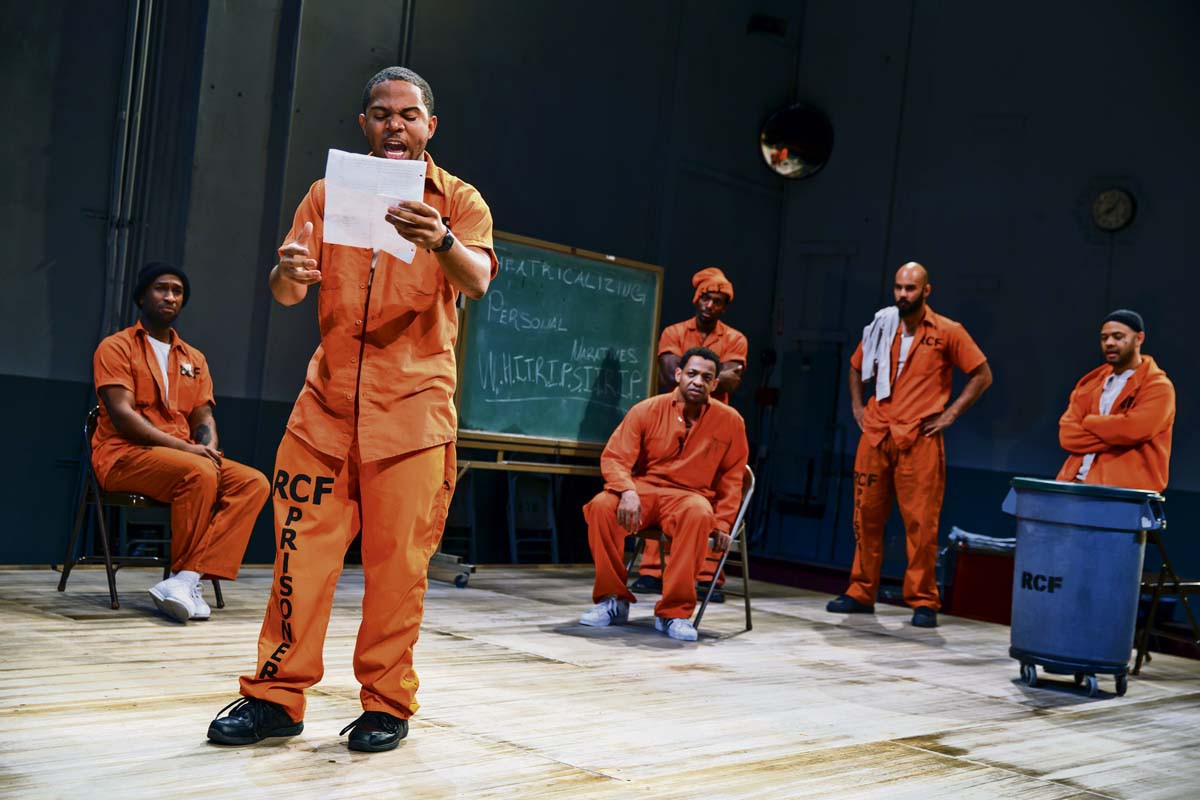
The first thing we noticed was how bare the stage was. The prop tables were visible; there were rusted folding chairs, and a single chalkboard. Strikingly, there were no curtains; nothing separating the performance from the audience. Then Derrick Baskin appeared holding a pamphlet that we would learn more about later. Baskin started and the way the audience immediately stopped their conversations was astonishing (I wish my students did that too!). As soon as he opened his mouth I was engaged, and this remained true for the next hour and forty minutes. I cried. I laughed. I was shocked. I was speechless. I was upset. I was angry. I was moved.
Whorl Inside A Loop is loosely based on Sherie Renee Scott’s autobiography. The play is told from the perspective of The Volunteer (Scott), a white Broadway actress who agrees (that’s what we are led to believe at first) to teach 12 classes at a maximum-security prison. The cast is primarily African-American men who, in addition to portraying the inmates the Volunteer works with, hold numerous secondary roles, like the prison staffers and the Volunteer’s sassy friends and family, with whom she shares the tales of life “behind bars.”
Derrick Baskin, Nicholas Christopher, Chris Myers, Ryan Quinn, Daniel J. Watts and Donald Webber, Jr all blew me away with their performances. I could go on about how amazing the actors were, but in that moment I was grateful that actors like these EXIST and that I was able to see them. While the show primarily features the interactions between the Volunteer and the inmates and friends, the true story and heart lie in the unfortunate courses of the men’s lives that are slowly revealed through the retelling of their experiences as personal narratives. It was in the inmates’ disadvantaged upbringings and the unfortunate circumstances that led them into crime in the first place and the long sentences they had to serve. It’s these narratives and stories that make this piece of theatre disturbing and, most importantly, real.
It is the vivid writing and compelling performances that successfully humanizes each of the prisoners, despite the fact that the men are all convicted murderers. A standout, Derrick Baskin brings a calming sincerity to his character, nicknamed Sunnyside, whose life took a dark turn at 13 after he saw his mother being arrested. He is described as the nicest person you’ll ever met, while the crime he is in prison for is unforgivable. The entire time, the audience is left to wonder how such a warm, optimistic man like Sunnyside could be capable of such a thing. Also imprisoned while still in his teens is Jeffrey, played brilliantly by Chris Myers. His life fell to pieces when his mother contracted HIV and died a year later. Completely devastated and having lost his way, Jeffrey confessed to a killing that he didn’t commit. His story and that performance were so deep that you could only hear the sniffling of audience members who were crying in the theatre.
The other actors are just as amazing. Nicholas Christopher, as Rick, recalls in haunting detail witnessing another inmate kill a prison official who had denied him the chance to attend his mother’s funeral. Daniel J. Watts gives a rhythmic reading of his character’s personal narrative. Ryan Quinn, as Source, doesn’t want to perform the story of his crime, saying, “Re-enacting it feels like glorifying it.”And Donald Webber Jr., as Bey, tells the heartbreaking story of a childhood encounter with a sheriff when he was only four years old that marked him for life.
The play also raises issues about the overwhelming number of Black men in prison, the importance of rehabilitation, and the unjust workings of the justice system. As the Volunteer observes at one point, “I think that I’ve done things that, if I were a Black man, I wouldn’t have gotten away with.” It was that aha moment that made me wish more shows like this could be produced.
Whorl Inside a Loop does not glorify these men or the crimes they admitted to committing. But as an audience member, it’s hard to listen to these stories without feeling an overwhelming sense of sympathy (or even empathy), sorrow, and lost hope over how their childhood experiences of poverty, abandonment, drugs, and neglect shaped the trajectories of their lives. The show can be summed up in a single line of the Volunteer, describing their narratives as “stories about guys who’ve lost their lives, but are still living.”
All performances are at Second Stage Theatre Midtown West located at 305 W. 43rd St. Tickets are on sale and can be purchased here.



[…] you may recall back in September, Broadway Black was in attendance at opening night for Whorl Inside A Loop at Second Stage Theatre. Since then, the show has been rumored to be making […]
[…] Whorl Inside a Loop, a well-regarded actress agrees to teach six inmates how to tell their stories behind the bars of a […]
[…] Whorl Inside A Loop is a story about an actress who teaches six felons how to tell their stories, at least according to Scott and the show’s website. It has received rave reviews from the “New York Times” and “The Huffington Post.” It premiered at the Second Stage Theater this summer where they even extended the run of the show. We were there on opening night. […]
[…] is something beautiful happening at Second Stage Theatre. Having been to the same theatre to see Whorl Inside A Loop, I was pleasantly surprised to see how they made the space fit into the setting for Invisible […]
[…] songs with Frenchie Davis & most recently the dynamite performer Daniel J. Watts (Whorl Inside A Loop, After Midnight) to issues of this country including bringing awareness to police brutality. Check […]