


I first read Shakespeare’s “Julius Caesar” as a junior in high school. I recall rushing through the play to move onto Othello, figuring Shakespeare’s tragedy on the Moor who loved Desdemona would surely be more exciting than his tale on a Roman leader who was known more for his love of an Egyptian queen than anything else. After attending Gregory Doran’s adaptation of “Julius Caesar” for the Royal Shakespeare Theatre at the Harvey Theatre for the Brooklyn Academy of Music, I must say I may have committed a mistake in my childish haste.
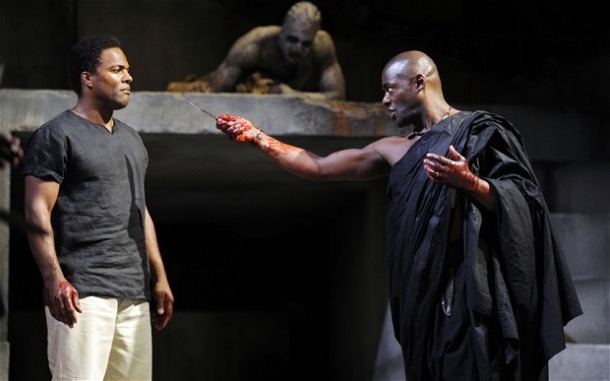
In this adaption, Shakespeare’s story on the fate of the Roman general is transplanted to an African nation, and embeds a heavy Western African feel to it. The colors, the music and the costumes all allow for viewers to feel as if they are watching a drama unfold about a leader they could have heard about on the BBC, and not some historical figure that now lives only in the pages of history books. The title character is portrayed by Jeffrey Kissoon who provides Caesar with a true sense of familiarity and humanity. This Caesar does not come across as a physically imposing and dominating leader, but more so as an aging general who views his fears and uncertainties of his future and that of Rome as weaknesses to conquer just like a military campaign.
Ray Fearon’s Marc Anthony doesn’t give off the usual image of a soldier who served Caesar with a faithfulness that bordered on blindness. Instead, we see Anthony as a man who looked up to Caesar with a love that a son may have for a father. After the death of the leader Anthony take up the reigns to let the truth of what has happened to be known by all Romans with a strength and commitment (that has never quite been visible in other adaptions), and to spur the citizens into seeking justice for the crime that was committed on the Ides of March.
It is in the performance of Brutus by Paterson Joseph that we find a rather complex character. Joseph’s Brutus comes off assured yet uncertain about the course of action he has decided to partake in. His monologues and interactions show a man who’s guilt but sense of duty clash head first into one another. And in his scene with his wife Portia (Adjoa Andoh) we see a marriage that is being wracked to the core by government, politics, conspiracy and secrecy. We are allowed in to the see the psychological effects of what it means to live in a time where nothing was certain but upheaval, chaos and death.
This production is nothing short of perfection. In moving “Julius Caesar” to a more contemporary time and location, viewers are allowed to let their imagination roam even while the genius of the actors induces the suspension of the mind. The audience is given the opportunity to assess the characters in their glory and their faults and figure out who truly is the victim and villain. And lastly, in my case at least, it has created a desire to revisit the play in its written form to take in its essence as I failed to do so long ago as a student.



Comments are closed.