

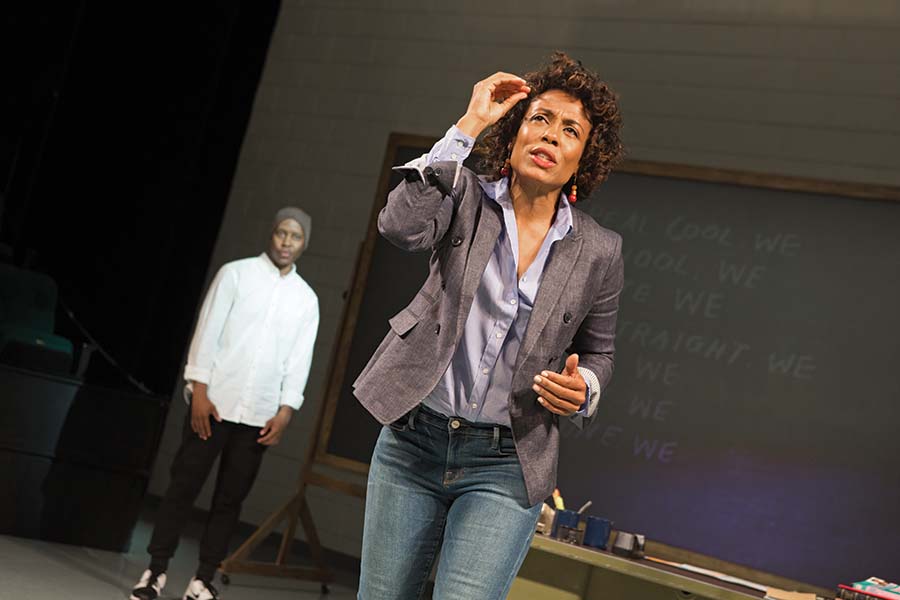

We real cool. We
Left school. We
Lurk late. We
Strike straight. We
Sing sin. We
Thin gin. We
Jazz June. We
Die soon.
In 1960 Pulitzer Prize winner Gwendolyn Brooks’ haunting crescendo from innocence to downfall, “We Real Cool,” was published by Harpers. In 2017 Dominique Morisseau humanizes and harmonizes with the Youth experience by following a similarly eerie trajectory, in her newest play “Pipeline.”
Walking into the Mitzie E. Newhouse theater and being met with the familiarity of harsh fluorescent lights and institutional cement block walls, will humble you. For 90 minutes of your life, you’re back in a classroom and the choice is yours on who is going to be your instructor. Enter Nya (a sharp and haunting Karen Pittman), an inner-city public school teacher and mother. Enter Omari (a brilliantly magnetic, Namir Smallwood) a private school attendee and son. Both professors in their own right, they quarter 90 minutes across the war zone of a mother whose every move is to protect her son and a son who’s fighting to deflect the de-humanizing compartmentalization of his surroundings. The title of the play, “Pipeline,” is a direct reference to the national trend where students are funneled through a pipeline from school to prison due to zero tolerance policies which criminalize over minor infractions.
If Morisseau wasn’t already on your radar, look now. Where there could have been didactic language, there’s deep dialogue. Where we’d normally see over-explanation to compensate for a lack of understanding the Black experience, we see compassion. Morisseau lays a genuine and raw foundation for the voices of her characters to sing from. She fleshes out everyday heroes—mothers, fathers, teachers (Brava, Tasha Lawrence! A standout.), students, and security guards (a charming Jaime Lincoln Smith) –who are all just trying to do the right thing.
Lileana Blain-Cruz’s direction and staging is the microphone that amplifies the tight harmonies and arrangements between this stunning 6-member cast. Within this composition, the duets resonate the loudest. That is the poetic, song-like exchanges that Morisseau has penned in the sweeping, full-range of emotion and complication that makes up the key of humanity, that we confuse as dialogue.
Father + Son
Mother + Son
Mother + Father
We are reminded that life isn’t easy, family isn’t perfect, and resolution isn’t promised. We’re reminded that life isn’t promised.
The interactions between Omari and his girlfriend Jasmine (a passionate and wise, Heather Velazquez) move me the most. Too often we dismiss the validity of feelings such as love or fear, based on age and experience. Morisseau gives the voice of our youth bass and credibility.
If this play was a thesis, I gather it postulates, why do we not see people for the entire human being they are? Why do we not take the time to understand the factors behind circumstance?
Omari’s classroom violence. Xavier (Morocco Omari) and Nya’s failed marriage. Nya’s crippling anxiety. Xavier’s absentee fatherhood. Nya’s infidelity. None of these events stand alone. The question now is: do we take this story as a mere page out of a textbook, or a reminder on how to live life through a lens of radical empathy?
Pipeline doesn’t seek to answer large questions for us, rather it invites us into the classroom to be part of this eloquent and intelligent debate.
Pipeline
Lincoln Center’s Mitzi E. Newhouse Theater
Written by Dominique Morisseau; Directed by Lileana Blain-Cruz
Set design by Matt Saunders, costume design by Montana Blanco, lighting design by Yi Zhao, sound design by Justin Ellington.
Running time: 90 minutes, no intermission.
Pipeline will run through August 27, 2017



[…] “We Were There” Check out our review of the 2017 production […]